Rethinking “Dog Food” vs “Human Food”
We often talk about dog food as if it belongs in a completely different category from the food we humans eat. But food is food.
Read that again, Food IS Food
It is simply bundles of nutrients, be it proteins, fats, carbohydrates, fibre, vitamins and minerals, all wrapped up in different ingredients and prepared in different ways. Our bodies and our dogs’ bodies don’t read labels, brains can read sure, but dogs don’t read they respond to nutrients we give them.
Dogs have lived beside us for thousands of years. They have shared our homes and our leftover meals for a very long time, and because they shared our scraps the domestic dog has adapted to eat a lot of what we eat. In other words, science bit, through domestication dogs have become highly adaptable omnivores. They can thrive on a wide range of diets, just like us, from meat-based meals to recipes that include vegetables and carbohydrates. Their needs aren’t identical to ours, but they are not from Mars either.
Dogs and domestication, plus why it’s important
Dogs evolved alongside us, so it makes sense that their diets have come to mirror aspects of ours. Selection over thousands of years has favoured dogs that could digest and utilise (or use) foods common in human environments, including starches. This doesn’t make dogs “little humans,” far from it, but it does mean they are flexible eaters whose diets can include both animal and plant ingredients.
That shared history is part of why the idea of “food is food” it important for us modern (none cave person dog owner). Many of the ingredients we cook for ourselves like chicken, rice, peas, carrots, sweet potato, can also form elements of appropriate meals for dogs when used based on a dogs indivudal needs.
In this blog I want to explore the idea that there isn’t a dividing line between “human food” Vs “dog food.” Instead, there is food that is appropriate for dogs, just as there is food that is appropriate for humans based on our needs, including medical issues, life stage (older or younge) and exercise level. The categories of nutritional needs overlap much more than most people realise.
I’ll cover (in my round about way):
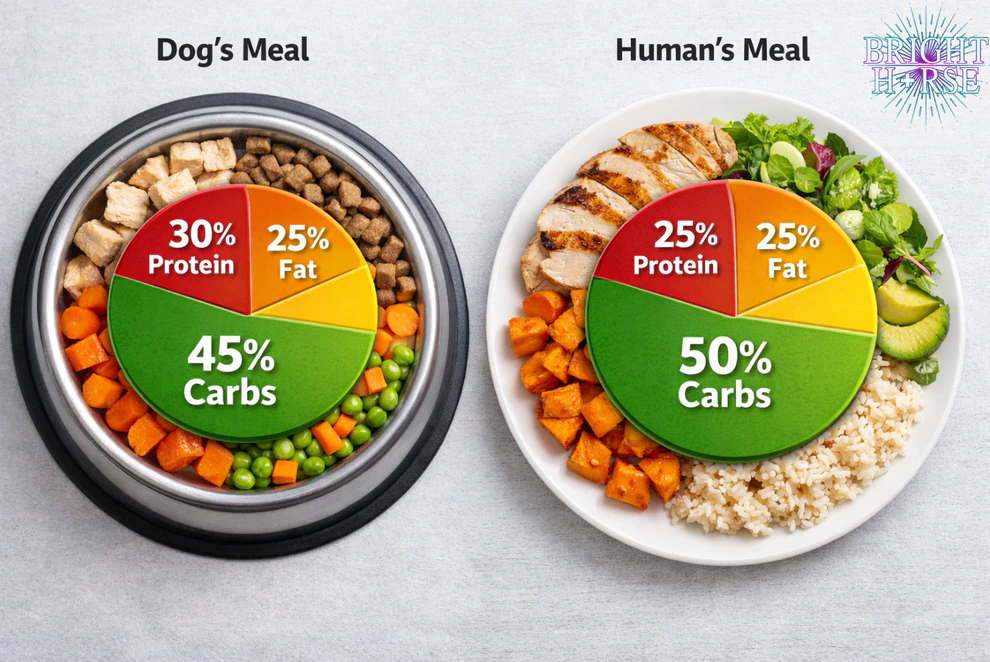
- Compare typical macronutrient distributions for dogs and humans
- Discuss the pros and cons of commercial foods
- Look at ways to add variety and fresh ingredients safely
- Share simple recipe ideas I use for my own dog
- Talk about convenience, emotion, and the realities of modern life with dogs
This isn’t about perfection or rigid rules, I don’t believe in rules #ImSoPunkIKnow…. It’s about balance and variation over time, compassion for ourselves as caregivers (Compasssion, read it again), and feeding practices that support the health, behaviour, and wellbeing of the dogs we love.
It’s all about balance and variation because, when we give a balanced diet to our dogs, they’re going to have better immune system, they’re going to have better gastrointestinal health, cope with diversity & changes when they come (cos change will come, it always does).
It is just like us, if we only eat the same thing every day, we’re going to miss something important our body needs.
Note: This article does not replace veterinary advice, and dogs with medical conditions or special dietary needs should be fed under veterinary guidance. The examples I share are based on what works for my own dog and my lifestyle, clinical expertise and legal tell me to say “not one-size-fits-all prescriptions.”
thanks legal
Looking at nutrients rather than labels
#LabelsAreGiftsUndertheTreeNotForYou&Me
One helpful way of thinking about food is to move away from brand names and packaging and toward nutrients and balance, which can be hard so think of it as variation in your dogs diet.
Both dogs and humans need:
Protein for muscles, enzymes, and repair = meat
Fats for energy, hormones, skin and coat health = the fatty tissue
Carbohydrates as an efficient fuel source = rice, carrots, sweet pot.
Fibre for digestive health = green veg (that is safe, see safe list)
Vitamins and minerals for countless metabolic processes
The proportions of each catergory differ between species and life stages, a puppy or a for example a babay will need something different to an adult (human or dog), but the building blocks are the same, it’s just the ratios are different. This simple pie-chart comparisons of how calories from protein, fat, and carbohydrates are typically distributed in dogs and humans. The aim isn’t to claim dogs are small humans, they aren’t, but to show that the same basic macronutrient concepts apply to both.

Where commercial diets fit in, cos they do
Commercial dog foods exist for good reasons, they do I promise. They are convenient, widely available, and formulated to be nutritionally complete. There are also veterinary therapeutic diets designed for specific medical needs such as pancreatitis, urinary tract health, kidney disease, allergies, or growth and reproduction. These can be incredibly valuable and sometimes essential for your dogs health.
But convenience sometimes brings unintended consequences. When we buy the same bag or the same tinned meat month after month, years after years, our dogs can end up eating the same meal every single day. Nutritionally complete does not always mean interesting, varied, or enriching.
Food is not just fuel; it is also experience. And has an impact our how they can cope with change as they grow and develop, we want to set them up for sucess.
Bringing Balance and Variety to the Bowl
Ok that is all well in good but we need a practical bit: what we need as dog owners is what balanced and varied feeding can actually look like in everyday life. It needs to be achievable and something we can do every day to support our dogs.
Feeding our dogs doesn’t have to be an all‑or‑nothing choice between only commercial food or only home‑prepared food. Many families, myself included, sit comfortably in the middle. We use complete commercial diets for convenience, and we add fresh foods, textures (crunchy carrots, yum yum), and flavours for variety (liver, chicken, or peas) and add in enrichment.
The goal here isn’t perfection. It’s aim for better variety, not perfect nutrition, balance over a life time rather than obsessing over every single bowl. No one expects that from you, I promise you we ’experts’ don’t achieve perfect… cos perfect is a fantasy. #SpidermanMuch
Pros and cons of commercial dog food
Commercial foods exist for good reasons, and they bring real benefits, no they do! I am not dismissing them, I use them, they are great for adding much needed gaps in what I can provide, again it is all about balance so here are some pros and cons.
Pros:
- Convenient and consistent (consistent is based on batches, batches will vary)
- Formulated to be nutritionally complete, please check out Waltam (https://www.waltham.com/resources/waltham-booklets )
- Easy to store and give portions
- Life‑stage options (puppy, adult, senior)
- Veterinary therapeutic diets available for specific conditions (e.g., pancreatitis, urinary issues, kidney disease, allergies)
Cons:
- Highly processed, science/research has shown that some research suggests associations between highly processed diets and long-term health risks., immune issue, allergies (among many species not just dogs).
- The same bag or tin for months = sensory monotony, could like to nutrional defects. Can lead to behavioural issues (“Sensory monotony doesn’t mean a food is deficient, but it can reduce dietary flexibility and enrichment.”)
- Less variety of smells, textures, and temperatures, leading to gastro issues (primary) or behavioural (secondary)
- Feeding can become refuelling instead of enrichment and/or meeting dogs behavioural needs.
Commercial food is not the enemy — it is a tool. How we use it is what matters.
Home‑prepared food and where it shines
Adding fresh foods can add a lot to our dogs, without adding to our bills or time. Actually it can be cheaper, and often saves us time. A 1kg bag of carrots costs €1.29, one carrot costs €0.13…. 13 cent for fiber, carbs, vitimins and enrichement… done!
- Fresh foods increase moisture intake, there is water in fresh food, as most commercial food (kiblle) is dehydrated for shelf life and shipping weight.
- Provide fibre variety, fibre is so important for all of us (humans and dogs) and fresh food provides this better then anything.
- Add colour, aroma, and novelty, more vitamins and variety support immune function and behaviour.
- Support the gut microbiome through different plant fibres (I will cover gut micobiome and behaviour in another blog)
- Allow single‑protein meals for sensitive dogs
And let’s be honest, many of us simply enjoy cooking for our dogs, we love giving our dogs a treat and feeding them at the AM & PM meals. It is part of the joy of having a dog, it’s relational, soothing, and meaningful… I personaly love it and so does my husband. We as humans enjoy another person or animal enjoying the food we give them, it is part of us.
Simple fresh additions most dogs can enjoy with out much effort
However, fully home‑prepared diets (without supplementation) can miss essential nutrients such as calcium, iodine, zinc, and omega‑3 fatty acids. That is why many people, myself included use a mix of home‑prepared foods plus complete kibble or recipes, balanced by a veterinary nutritionist. This blended approach keeps things safe and interesting.
Here are examples of foods often used safely in small amounts alongside a complete diet (always introduce gradually and check for individual intolerances):
- Cooked chicken or turkey (no bones, no seasoning)
- Lean mince or lightly cooked fish (no bones)
- Raw or cooked carrot, cook sweet potato no skins, or pumpkin
- Peas or green beans, broccoli or cumcumber
Always avoid toxic foods such as grapes/raisins, onions/garlic, chocolate, alcohol, xylitol, macadamia nuts, and cooked bones. If in doubt, check before feeding.
A few example meals from my own kitchen
In my house, meals change across the week, again variation is important meals plsu enrichment. A typical week might look like this:
- A base of complete kibble mixed with…
- Home‑cooked ingredients such as chicken breast/turkey mince, peas, carrots, and sweet potato.
- I also do Salmon Saturday for omega‑3/6s to support joint health (Aldi/Lidl do tins of salmon)
- Different single‑protein enrichment across days (duck neck, lumb lung, beef liver, rabbit ear) rather than mixing several in one bowl, so the lamb lung, duck neck, chicken hearts and rabbit eats included in enrichment outisde main meals.
This keeps macronutrients balanced across time while giving plenty of variety to support behavioural needs, doesn’t need to be every day.
Transitioning foods gently
When adding new foods it is imporant to make changes gradually over 5–7 days, make sure to mix a small amount of the new food with the old; simple, small = good change. Keep an eye on stool quality and comfort, if your dog struggling to poop? If vomiting, diarrhoea, or discomfort occurs stop and please check with your vet there might be more going on.
Most dogs adapt well when transitions are slow and calm, if there is nothing else going on the transition should be smooth, if not - check it out with a vet. Remember Dogs evolved with us, if you struggled to eat and digeste food what would you do?
Convenience & Compassion. A Reality of Everyday Life
The final part of this blog is about something we do not talk about enough when it comes to how we feed our dogs: real life.
Food isn’t only about nutrients, I’ve already touch on this. It is also about time, energy, money, emotion, routine, culture, and where we are in life. What we feed our dogs is often shaped as much by our own capacity, the time and money we have, as by our nutritional ideals for our dogs. Perfect is not the goal, progression is.
Convenience food is not the enemy
There will be times in life when work is too much, sleep avoids us, health or family life is overwhelming. During those time we turn to convenience, because we need a break. And that is ok, many of us lean more heavily on commercial diets because they are:
- Quick
- Predictable
- Easy to store
- Already balanced
I have been there myself during periods of very long working hours, for my sins I worked for Pfizer during the time we don’t speak of (cough Covid). I stepped back from cooking for my dog for a while and relied on good‑quality commercial foods, because times were intense and I wasn’t able for doing anything else. That wasn’t a failure of love for my dog. It was an act of self‑preservation, so that I could keep showing up for my dog in other important ways. When I was able to make her food again I did.
Convenience food has a place. The issue isn’t the occasional easy option, it’s when life becomes so pressured that everything has to be convenient all the time. If we feel like everything needs to be a convenience to get through hard times, and those hard times last most then a few months, then something else here needs support.
Sometimes I am busy and, I’m not able to sit down and do enrichment the way I want to or feed my dog the best food I can possibly. That’s ok. Honestly it is, you have not failed your family.
When have we ever given ourselves the best diet that we can? Best breakfast, best lunch, best dinner. There are times when, we do just want McDonald’s. And what I say to people is, not a shout out to McDonald’s because I actually can’t remember the last time I ate at McDonald’s. I’m more of a Doner kebab, abracadabra kind of girl! (We have no preferred brands here)
What I like to say to people is it’s fine to do the quick, simple meals every once in a while. They’re a treat, but they’re not every day. It’s fine to have convenience food, but we don’t want to have convenience food for ourselves or our dogs every single day, because if that’s happening, then something else is failing. If we need to find something that’s so fundamentally important to us, cooking food, sitting down with family, eating a healthy meal, and we have to constantly make it convenient, then we are overworked, we’re burnt out and something else in our life needs to change.
It’s a reflection of everything else that’s going on. And as human beings, we should enjoy cooking food, it should be part of our social integrity. Feeding the animals that we care about, whether that’s horses, dogs, or cats, like, it’s actually something we really enjoy doing as a human species. So for finding that becoming a chore, and this is just what’s convenient, then I think it’s important to talk about the emotional part of that as well, that that potentially could be that there’s something else going on in our lives that we need to have a look at.
Caring for ourselves so we can care for them
Feeding animals we love is deeply human, it is part of our history and gentics. It is social, emotional, and relational, we love to care and support our family. so wen feeding starts to feel like a chore or an impossible task, it can be a sign that we are:
- Burnt out, low and life is hard
- Over‑scheduled, “I don’t have time”
- Carrying too much, Work and life is taking too much
In those moments, the kindest step may not be a new recipe — it may be asking what support we need. And I’ve been there, cos all humans have been there.
Self‑care, revoery and dog care are not competitors. They are intertwined. A rested, supported caregiver (that you and me) is better able to:
- Notice subtle changes in appetite, weight, or behaviour, and make changes that are needed.
- Prepare food with enjoyment rather than resentment, or the feeling of “I should just get this done”
- Use feeding time as bonding and enrichment rather than a stress point, and add to our happyness and remind us why we love them
The story we tell ourselves matters
If we tell ourselves, I wil tell you know I have been there and I have told myself the folowing nonsense:
- “I’m failing because I’m feeding kibble right now,”
We add guilt on top of exhaustion. A more truthful story is actually….
- “Right now I need convenience. When life steadies, I can add more variety again.”
Two things are happening, guilt that you can’t be your best self cos you need a break and a thought distortion (psychology baby), it isn’t real it is negative self talk. It is ok so take a break, ignore the dick head brain.
Food choices ebb and flow across a dog’s lifetime, just as they do in ours. What matters most is the overall pattern:
- Generally balanced nutrition
- Some variety over time
- Safety and veterinary guidance when needed
- Room for both home‑prepared and commercial foods
Bringing it all together
So where does this leave us? Take home message tome -> Food is food, nutrients first, labels second.
Dogs and humans share overlapping, we grew up together, yes there are difference, though not identical, nutritional patterns are there.
Commercial foods have real value, don’t feel guilt using them but don’t rely on them; home‑prepared foods add variety and enrichment.
Balance happens over time, not in every single bowl. Please remember variety is the most important things, as and when you can.
Last note, Your wellbeing matters too. If you need a break, that is ok, be kind to yourself.
I hope this Blog gives you permission to be both thoughtful and flexible with how you feed your dog, then I’ve done my job.
Feeding isn’t just about keeping our dogs alive. It is about connection, health, enjoyment, and care, for them, and for ourselves.
Be kind to youself, you are doing great