Understanding Problem Behaviours Between Dogs
Reactivity between dogs (that’d dog on dog) isn’t just “a bit stressful.” For a lot of people, it means feeling genuinely anxious about going for a walk. You start picking quieter times of day, avoiding certain routes, constantly scanning the environment the second you step outside.
You see another dog in the distance and your whole body tenses. If a dog is off lead, it’s panic. You’re not thinking about enjoying the walk anymore, you’re thinking about how to get out of the situation safely.
For some people, it gets to the point where they just stop going out altogether. Because it’s too much,it feels unpredictable. Because you’re worried something is going to happen, to your dog, to another dog, or even to you.
That’s not what you signed up for when you got a dog. While it is true your dog is not trying to be difficult, they’re overwhelmed and trying to cope, you’re not wrong for feeling like this either. This is stressful. It is exhausting. And it can feel incredibly isolating when it keeps happening day after day.
What Does Dog-Dog Reactivity Look Like?
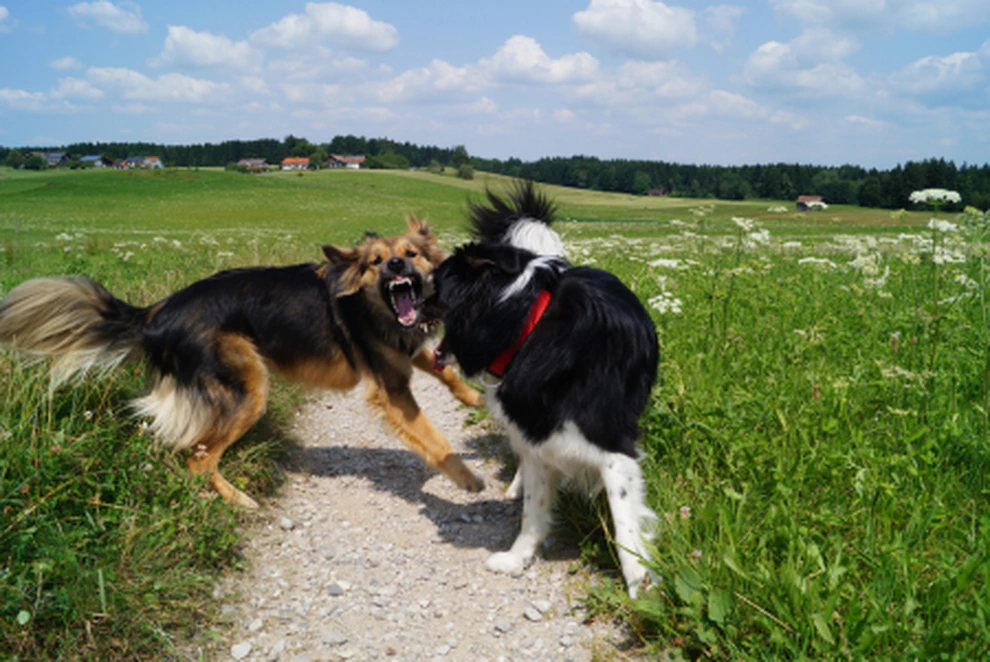
It doesn’t always look the way people expect. Some dogs bark, lunge, and growl the moment they see another dog. Others go very still, they freeze, stare, or fixate. Some try to hide behind their owner or avoid the interaction altogether.
And then there are dogs who seem “fine”… right up until the other dog gets too close and then suddenly, they react.
This is part of what makes it so difficult to manage. It can feel unpredictable, like it comes out of nowhere, especially when you’re just trying to get through a normal walk.
But these behaviours aren’t random. They are what we call distance-increasing behaviours, your dog is trying to create space between themselves and something they’re not comfortable with. That might look like barking and lunging and it might look like freezing or avoiding.
Different dogs use different strategies, but the goal is the same: “I need more space.”
Why Does It Happen?
Reactivity isn’t about your dog being stubborn, dominant, or “just badly behaved.” It’s about how they feel in that moment.
Dogs react because of fear, stress, frustration, or confusion. When you see barking or lunging, you’re not seeing the problem, you’re seeing the result of an emotional response that’s already there.
In many cases, your dog is trying to say: “I don’t feel safe, I need space.” For some dogs, that comes from past experiences, a bad interaction, being overwhelmed, or repeated situations where they felt they couldn’t cope. For others, it’s a lack of safe, positive exposure early on. If a dog hasn’t learned that other dogs are predictable and safe, they’re more likely to respond defensively.
There’s also something we call barrier frustration, where a dog wants to get to another dog, but the lead prevents it. That frustration builds, and what comes out can look like aggression, even though the underlying emotion is very different. And genetics play a role too. Some dogs are simply more sensitive to their environment, more alert, or quicker to respond when something feels off.
It’s also important to consider pain or underlying medical issues. Discomfort can lower a dog’s tolerance and make them more likely to react, especially in situations they already find challenging. If behaviour has changed suddenly, seems inconsistent, or doesn’t follow a clear pattern, this should always be explored.
If you think this might be a factor, I’d strongly recommend reading more about it here How Health Issues Influence Behaviour
So while the behaviour might look dramatic or sudden, it’s not coming out of nowhere. It’s your dog doing the best they can in a situation they don’t feel equipped to handle.
What People Often Get Told (And Why It Backfires)
By the time most people reach out for help, they’ve already tried a few things.
They’ve been told to:
- “just control your dog”
- “correct the behaviour”
- “use a tool to stop it”
- “they’re just being protective”
- “they’ll grow out of it”
And on the surface, some of this advice can seem to work, at least for a short period of time. But then things come back, often then come back worse then before. That’s because these approaches don’t address what’s actually driving the behaviour.
“You need to control your dog.” This often leads to more tension on the lead, more corrections, and more pressure in the moment. But if your dog already feels unsafe, adding pressure doesn’t teach them how to cope — it just confirms that the situation is something to worry about.
“They’re being protective of you.” This is a very human way of interpreting behaviour. In reality, most dogs aren’t trying to protect you, they’re trying to protect themselves. Those distance-increasing behaviours are about creating space, not guarding you.
“They’ll grow out of it.” In most cases, they won’t. Avoiding the problem or hoping it improves with time often means the dog gets more rehearsals of the behaviour, and it becomes more ingrained.
“Use this, it stops pulling/reacting instantly.” Quick-fix tools can suppress behaviour in the moment, which is why they appear to work. But they don’t change the underlying emotional response. What often happens is, you get a short-term improvement, then the behaviour returns and when it does, it’s often more intense. Because now you’re dealing with both the original emotion and the association created by the tool.
This is why so many people end up feeling stuck. They’ve done exactly what they were told to do and it hasn’t helped long-term.
Not because they’ve done anything wrong, but because the advice they were given didn’t address the actual problem.
Why Punishment Makes Things Worse
When we try to stop reactive behaviour using corrections or aversive tools, we’re often using what’s known in behavioural science as punishment.
That can include:
- Positive punishment (adding something unpleasant): for example, a leash correction or a sharp “no” when your dog reacts
- Negative punishment (taking something away): for example, ending the walk or removing access to something your dog wants
These approaches can reduce behaviour in the moment. That’s why they’re so commonly recommended. But they don’t address the reason the behaviour is happening in the first place.
More importantly, they change what your dog learns about the situation. Dogs learn through classical conditioning (learning by association). So if your dog sees another dog and, at the same time, experiences discomfort, frustration, or pressure from the lead, the association becomes: “Other dogs = something unpleasant happens to me.”
That emotional response builds over time.
So while the behaviour might look like it’s improving at first, what’s often happening underneath is:
- increased tension
- increased sensitivity
- a stronger negative emotional response
And eventually, that comes back out as more intense behaviour. This is why so many people say: “It worked for a while… and then it got worse.” (this is usually when I get a phone call). Because the behaviour was being suppressed, not understood or resolved.
What actually needs to change is not just the behaviour, but the emotional response driving it.
That’s where approaches like, counter-conditioning (changing the emotional association) and desensitisation (gradual, controlled exposure) come in. Instead of teaching your dog to “stop reacting,” our goal is to teach them “This situation is safe. You can cope here.” And that’s what leads to real, lasting change.
What Actually Helps (And Where to Start)
The goal isn’t to control your dog through these situations. It’s to help them feel differently about them. That starts with creating space before your dog reacts, choosing quieter routes, giving yourself distance, and avoiding situations that are simply too much for them right now.
From there, we focus on changing the emotional response. That’s where approaches like counter-conditioning (changing what your dog associates with other dogs) and desensitisation (gradually exposing them at a level they can cope with) come in.
This is how we move from; panic → tolerance → calm behaviour Not overnight. Not through force. But through consistent, structured work that your dog can actually succeed in.
And importantly this is a very common issue. Which means we have a strong body of research, practical experience, and proven methods to work from. There are clear, evidence-based ways to approach this — not guesswork, and not quick fixes.
You’re not stuck. And you’re not alone in this.
5 Things Every Guardian of a Reactive Dog Should Know
Dog-dog reactivity is one of the most common challenges I see and it’s exactly why I put this together. If you’re not sure what’s normal, what’s a red flag, or where to even start, this guide will help you:
- understand what your dog is actually telling you
- recognise what’s helping vs what might be making things worse
- take the first steps toward calmer, more manageable walks
If you’re at the point where walks feel stressful, unpredictable, or just not enjoyable anymore, this is a good place to start.
Sign up below to get your copy of my guide and access the full 6-part email series.
References
- Landsberg, G., Hunthausen, W. and Ackerman, L., 2013. Behavior problems of the dog and cat. 3rd ed. Saunders Elsevier.
- Overall, K.L., 2013. Manual of Clinical Behavioral Medicine for Dogs and Cats. Elsevier Health Sciences.
- Horwitz, D.F. and Mills, D.S., 2009. BSAVA Manual of Canine and Feline Behavioural Medicine. 2nd ed. BSAVA.
- Moffat, K., 2008. Addressing canine aggression in veterinary practice. Veterinary Clinics: Small Animal Practice, 38(5), pp.983–1003.
- Mills, D.S., 2003. Medical paradigms for the study of problem behaviour: A critical review. Applied Animal Behaviour Science, 81(3), pp.265–277.
- de Souza-Dantas, L.M., Döring, D. and Hohlbaum, K., 2017. Aggressive behaviour in dogs – a review of diagnosis and therapeutic approaches. Veterinary Record, 181(13), p.348.
- Haug, L.I., 2008. Canine aggression toward unfamiliar people and dogs. Veterinary Clinics: Small Animal Practice, 38(5), pp.1023–1041.
- Casey, R.A. et al., 2014. Human-directed aggression in domestic dogs (Canis familiaris): Occurrence in different contexts and risk factors. Applied Animal Behaviour Science, 152, pp.52–63.