Listen to the Podcast:
Why Growling Is One of the Most Misunderstood Behaviours in Dogs
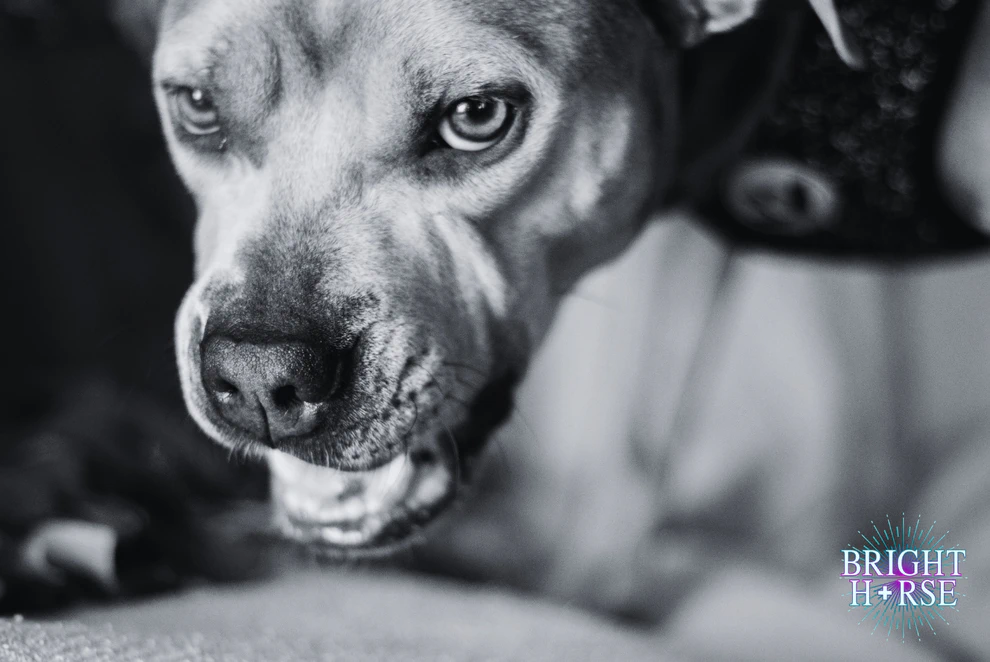
When clients come to me about growling, it’s rarely coming from a place of irritation, at their dogs behaviour, it’s coming from fear and that makes complete sense! The growl is scary, in certain contexts. You’re sitting there on the sofa, maybe you’re giving your dog a cuddle, or you’re just reaching out to touch them, and suddenly they growl. It catches you off guard and the first thought isn’t “communication”… it’s “Is this going to escalate to a bite?”. You are right, you recognise the warning.
So what do we do? We go looking for answers. We go to Google. We read forums. We try and understand why this is happening and what we should do about it. And unfortunately, what people are often told is, from these seraches,: “Your dog is trying to dominate you.”, “They’re being bold.”, or “They’re being naughty.”. Spoilers, they aren’t.
So the advice we might find online becomes: stop it, correct it, punish it. But here’s the problem. That advice isn’t grounded in behavioural science and more importantly, it doesn’t address what the dog is actually experiencing, that lead to the growl in the first place.
There’s also something else going on here that people don’t always talk about. Growling feels very different depending on the context. If your dog growls during tug of war, it can feel fun, even a bit sweet if it is a cute puppy growl (I love the cute puppy growl during tug of war, I know you do too you know it’s a fun play behaviour). We recognise it as play and we are correct in that context, there’s no concern there with our dogs in that moment of place. In a different context if your dog growls when you touch them, or when you go to move them of the sofa, or when they’re resting? That feels completely different, rightly so.
We feel confusion, concern, fear and sometimes there’s embarrassment. And for many people, there’s a real emotional impact cos “I love my dog… why don’t they want me to interact with them?” and that can hurt. I often think about how we handle similar situations with children. Most of us have been at a family gathering where a child is asked to go and say hello to a relative. Maybe shake hands with grandad, or give auntie a hug. And the child hides behind their parent. They don’t want to engage, they’re uncomfortable. We don’t label that as bad behaviour. We don’t force the interaction (or we shouldn’t). Because we recognise that the child isn’t ready yet, or doesn’t feel safe in that moment. And we adjust, we give them space to watch the adults interact, we might support them through it by asking questions about their favourite book or hobby, when they feel able. We understand that social interaction isn’t something that should be forced.
There’s also an element of consent there, which we are still learning as humans, but often fail with dogs or horses, we often do the opposite. We assume that because we (as the humans) want to interact, the dog should accept it. And when they don’t comply, when they communicate that they’re uncomfortable, we label that communication as the problem behaviour. And this is where things start to go wrong. Because the growl isn’t the issue. It’s the dog’s way of saying “This doesn’t feel okay right now.”.
In many of the cases I see, especially in adult dogs, there’s also something else going on underneath. If a dog is growling when being touched, when being moved of the sofa, around food, around certain spaces, it’s very often linked to discomfort, pain, or an underlying medical issue. Or a previous medical issue that needs behavioural modification.
That growl isn’t coming out of nowhere. It’s communication. And from a behavioural and welfare perspective, we should be listening to it, not trying to silence it. The challenge is, we’ve been taught to see growling as something to stop.
Dogs Are Always Communicating, Behaviour is Information
When I say “behaviour is information”, what I really mean is behaviour is the only information we have to understand our dogs.
Dogs are non-verbal communicators. Yes, we as humans, we recognise the bark, the whine, the growl. But the vast majority of their communication isn’t vocal at all. It’s body language. Subtle shifts, small changes, the yawn, lick lip or look away. All these things that are easy to miss if you don’t know what you’re looking for in dog calming signals. The bottom line is our dogs are communicating with us all the time, even if we don’t hear it or can’t see it.
The difficulty is, as humans, we are primarily verbal communicators as in we talk to each other. We rely on our words, as well as our body to communicate. So when communication is silent from our dogs, we often miss it, and when we miss it, dogs have to escalate to something we do notice, which means making noise (bark or growl).
That’s where dog vocalisation, i.e. growl, comes in, not because our dogs “jump straight to growling”, but because everything before it didn’t land for us humans.
Every behaviour that our dogs’ do has a function. Each behaviour serves a purpose for them, it meets a need they have at that time. From a behavioural science perspective, behaviour is influenced by both internal states (what’s happening inside the body, like pain, emotion, or physiological need) and external factors (what’s happening in the environment around the individual).
If you call your dog and you have food, they move towards you. That’s movement behaviour. They take the food, that’s eating behaviour. Each part of that sequence exists because it fulfils something the dog needs, to eat. We, as humans, are exactly the same. If the weather turns cold and we feel uncomfortable, we put on a jumper. That behaviour exists because we need to regulate our body temperature. It’s functional. It solves a problem for us in that moment.
Dogs are no different. So when our dog growls, it’s not random. It’s not defiance. It’s not a personality flaw. It’s functional. It’s the dog meeting a need in that moment, “Something isn’t right here.” or “I need this to change.”
This is where we often get stuck as humans, because we tend to label behaviour as “good” or “bad”. Those labels don’t really hold up when you look at them closely. They’re based on our own human social expectations. For example, if you were at a funeral and stood up and walked out halfway through, people might see that as bad behaviour. But if you had a medical condition and needed to leave to take care of yourself in that moment, that same behaviour suddenly makes sense.
So was it good or bad behaviour that you left a funeral in the middle of a eulogy? Or was it just behaviour that served a need? Context is everything!
It’s the same with our dogs. If your dog growls when you touch them, is that “bad behaviour”? Or are they responding to something we haven’t fully understood yet? Maybe there’s discomfort. Maybe there’s pain. Maybe they just don’t like being touched in that way or in that moment. The behaviour itself isn’t the problem, that is why I said it is information. And the more we start to see behaviour through that lens, the more clearly everything else begins to fall into place.
What a Growl Actually Means = A Distance-Increasing Signal
When we talk about growling, we often jump straight to labels like aggression. Aggression is an easy answer to a more complicated behaviour. A growl is what we, as behaviourists, call a distance-increasing behaviour. And while that might sound technical, it’s actually something we understand very easily in humans.
If someone walked towards you with their arms open, clearly going in for a hug, and you didn’t want that interaction, what would you do?
- You might step back. Look uncomfortable.
- You might put your hands up.
- You might turn your body away.
All of those behaviours are saying the same thing, “Please don’t come any closer.” That’s a distance-increasing behaviour.
Dogs do exactly the same thing. The difference is, they don’t use words or body language we understand. They use dog body language which looks very different, and when that doesn’t work if their human doesn’t speak their body language, they use vocalisation (bark, growl or whine). So when a dog growls, they are not being “bad”, “bold”, or “dominant”.
They are saying, “hey babe, me needs some space.” or “Please Sir, I’m not comfortable with this.” or flat out “Stop it”
We also have the opposite of this. Distance-reducing behaviours.
If you want a hug from a friend, you open your arms, you lean in and you both move closer. Dogs do this too in a different way. They seek proximity and closeness to each other by moving in an S-shape, the smell each other, the use calming signals and all of this we can see to uin human dog interactions. If they choose contact with use humans the do very similar behavours and this is where it becomes really important to recognise that our dogs are individuals and a different species, where we as the humans need to learn their language.
What one dog wants from you might be completely different to what another dog wants, and even within the same household or between humans they live with. My own dog, for example, loves physical affection from my husband. She will lie on him, seek him out, happily be a lap dog. She does not want that from me. And that’s OK (though I would love cuddles). That doesn’t mean there’s a problem in our relationship. It just means she has preferences, with me we do different things together. We go for walks, we play, we do enrichment. She still has choice in how she interacts between her humans.
Where things start to become more serious is when communication is missed. Escalation doesn’t come out of nowhere. It happens when earlier signals haven’t been seen, or haven’t been respected. If a dog is consistently having to move from subtle body language, to growling, to snapping, and potentially to biting, that tells us something very important, the communication system isn’t working.
And if a dog is going from what appears to be nothing straight to a growl, snap, or bite, then we need to take that seriously. In many cases, that is a strong indicator that something else is going on, particularly pain or discomfort. That is not something to train through, please don’t do that. .
So rather than asking, “How do I stop my dog growling?”, the better question is “What is my dog trying to create distance from—and why?”.
Why Punishing the Growl Doesn’t Work (and What It Teaches Instead)
When people ask “how do I stop the growl?”, I find this hard to answer because the first thing we need to understand is that stopping a behaviour isn’t a behaviour. This is where the dead man test comes in. If a dead dog can do it, it’s not behaviour. A dead dog doesn’t growl. A dead dog doesn’t bite. But a dead dog can be quiet. This is the dead man test.
When we say we want to “stop” something, we’re not actually teaching the dog what to do instead. We’re just trying to remove something we don’t like. And that’s where things start to fall apart, as when you punish a growl, what you’re actually doing is removing a form of communication. You’re telling the dog, “You can’t say that.” and your dog says “well what can I say instead that makes you listen…?”
When we punish the growl, we are not changing how the dog feels, why they need to say what they need to say. You’re not addressing the discomfort, the pain, or the need for space that caused the growl in the first place. So the need is still there, this is when they escalate. Because our dogs now have fewer safe ways to express themselves and this is where escalation happens, which we don’t want to happen.
If the calming signals were missed, the dog moves to a growl. If the growl is punished, the dog learns that growling doesn’t work. So what’s left?
- Snapping.
- Lunging.
- Biting.
The moment a dog snaps or bites, what do we do as humans? We move away, we pull our hand back and we stop what we were doing. From a learning theory perspective, that is negative reinforcement. Our dog learns, “Well that worked! the human finally listened to me! or “That got me space, I’ll do that again”. So now, instead of using a growl, the dog has learned that snapping or biting is more effective. We basically trained them, all be it unintentionally.
This is how people end up saying, “The bite came out of nowhere.”. It didn’t. No shame when I say that but I really need you to understand it didn’t come out of knowwhere, it is just dog behaviour. But now you know. The earlier communication just wasn’t seen, or it was punished out of the dog’s repertoire. But now you know better, and we are here to do better.
So rather than trying to stop the growl, we need to shift the question. What do we want the dog to do instead? We want them to be able to communicate earlier. More subtly. More safely. And that means we have to start noticing and responding to the behaviours that come before the growl.
Signals That Come Before the Growl
Before a dog growls, they have already tried to communicate. multiple times. The challenge is for us humans that most of that communication is silent for us, we don’t understand ‘dog language’. We call these calming signals, it is the ’take a chil pill’ behaviour. These are the small, often subtle behaviours that dogs use to navigate social situations and reduce conflict.
Things like:
- Looking away
- Turning their head
- Lip licking
- Yawning or sneezing
- Freezing in place
- Moving away from us
These aren’t random behaviours, “dogs just do”, they are dog language. The difficulty is, we either don’t see them, or we don’t recognise them for what they are. We might think the dog is being “good” because they’re being quiet. We might think they’re being “calm”. We might even continue what we’re doing, because nothing obvious has happened to us.
What do we need to do is respect the animals needs. Pause what you’re doing, stop the interaction and give them space. Even if you aren’t sure taking a break gives you more information. For example if your dog yamws and you stop the interaction, if they want more they will tell you by moving closer to re-engage with you.
Let that communication work. This is something I spend a lot of time teaching clients—how to actually see these signals. I use photos, videos, and practical examples so people can start to recognise what their dog is doing in real time. Because once you can see it, you can’t unsee it. And everything changes from there, for the better.
If your dog learns that these early signals are enough, that they don’t need to escalate, then they will keep using them. And that’s exactly what we want.
How Dogs Learn Whether Communication Works
Dogs learn from outcomes, this is learning theory and critical to how dogs learn. Quite simply, behaviours that work get repeated. Behaviours that don’t, fall away. We’ve already seen this in action. If a dog growls and it gets punished, that behaviour becomes less likely. But the need behind it is still there. So the dog tries something else. If that dog then snaps, and the human moves away, the dog learns: “That worked.”
From a learning theory perspective, that is negative reinforcement. The dog’s behaviour has successfully removed something they found uncomfortable. So what happens next? The dog is more likely to go straight to the behaviour that worked, reinforcement makes things stronger. Dogs don’t sit there trying to be “good” or “bad”.
They are simply learning:
- What works in this situation?
- What gets me what I need?
And they get very good at it.
We see this all the time in dog-to-dog interactions, where both dogs understand the language. One dog gives a signal, the other respects it, and the interaction stays calm. No escalation needed.
Real life, Changing How We Respond to Our Dogs
The difference for our dogs is us. If we don’t recognise the early signals, or we ignore them, or we punish them, we are shaping what our dogs learn works.
This section is about what do we do instead? We change how we respond to those signals, we want to make them stronger, we want to reinforce them.
When you see the early signals:
- Pause, Stop what you’re doing
- Give the dog space
- If you can, give the dog a food reward
Because the moment your dog learns, “That was enough.”, “I didn’t need to growl.” and “oh a treat!”
Everything starts to shift here as we are making the soft dog language stronger, which makes the growl less likely. And the change can happen very quickly here. Not because we’ve trained something complicated, but because we’ve finally started listening to how dogs talk.
Red Flags and Green Flags, choosing the Right Support for You & Your Dog
By this point, you might be thinking, “Okay… I understand it better now, but I still need help.” That’s completely fair. But choosing the right support is critical, this is not a CTA it is actual support, because the wrong advice can make things worse, not better. And I don’t care if you call me, I only want you to call the right person.
🚩 Red Flags If you hear any of the following, I want you to pause and seriously question it… then run away.
- “Correct the growl.”
- Talking about dominance, or your dog being “bold” or “naughty”
- Forcing interactions, flooding, or putting the dog in situations they are clearly uncomfortable in
- Ignoring body language or telling you to push through it
- Flooding, for example, is when a dog is exposed to something they are afraid of or uncomfortable with, without the ability to move away or cope. It’s overwhelming, and it does not teach the dog how to feel safe.
Another major red flag is when behaviour is looked at in isolation. If nobody is asking about your dog’s health, that’s a problem.
Growling can be linked to:
- Skin issues
- Allergies or intolerances
- Gastrointestinal problems
- Parasites
- Orthopaedic pain
- Injuries
- Arthritis (yes, even in young dogs)
If we don’t rule these out, we are guessing. And that’s not fair on the dog.
Do me a massive favour ask a trainer or behaviourist: “How long will this take to fix?”
And if they give you a fixed answer “six weeks”, “one session”, “no problem”, I want you to run.
There are too many variables, in every dog is different, every case is different. A good professional will tell you: “It depends.” Because it does.
✅ Green Flags
Good support looks very different.
- They talk about communication, not control
- They help you understand your dog’s behaviour
- They respect your dog’s signals
- They look at underlying causes, not just the behaviour itself
- They are happy to work alongside your vet to rule out medical issues
- They give your dog choice
- They also support you
A good trainer or behaviourist will not make you feel stupid. They won’t shame you. They won’t push you into doing something that feels wrong. They will work with you, compassionately, and help you understand what’s going on so you can make informed decisions for you an your dog.
I hope this has helped you understand a little bit more about growling, and what your dog might be trying to tell you.
If you’re concerned about your dog’s behaviour, or you think there may be an underlying issue, I have other blogs that go into more detail around aggression and medical causes .
I’d encourage you to read those and continue building your understanding.